What is dry fire?
When you dry fire, you go through all the motions of firing your gun, including pulling the trigger, when there is no live ammunition in it. We also use the term dry fire to indicate other types of practice we might do with an unloaded gun, such as learning how to use cover, rehearsing a good drawstroke, or simply checking out a new holster.
Dry fire can be very beneficial, especially for new shooters. It can help you avoid developing a flinch, or cure an existing one. Because it gets rid of noise and recoil, people who flinch often benefit greatly from regular dry fire.
Dry fire is usually more convenient than going to the range. It is a boon to shooters on a limited budget, because it allows you to practice basic gun manipulations without spending any money on ammunition. Through dry fire, you can build up thousands of repetitions of attaining perfect sight alignment, a perfect trigger squeeze, and a complete follow through without the expense of firing thousands of rounds.
When you are ready to learn to work from the holster, dry fire allows you to learn and then to perfect a smooth, safe draw stroke without the danger of an accidental or negligent discharge while you are learning. It also allows you to check out your new holster in a safe and controlled manner.
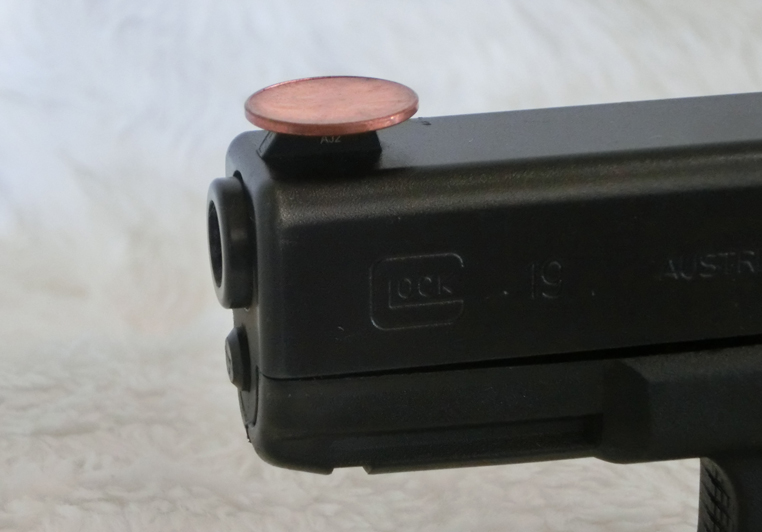
Don’t let the penny drop.
But there’s one nasty little drawback: dry fire is very dangerous.
Many, if not most, accidental shootings among good shooters are caused by someone dry firing in a negligent manner — while distracted, or while overtired, or while failing to follow all the safety rules. My range buddy’s former high school sweetheart was killed in just that way, shot through the head while she dozed next to her 8-month-old baby. The young man who killed her was dry firing his new gun in the house across the street. Well, he thought he was dry firing. But it turned out his gun was loaded.
If you doubt that dry fire can be risky, run a search for the words “negligent discharge” on any internet gun board (such as The Firing Line), and see how many tragedies and near-tragedies happened while dry firing.
Making it safer
The nice thing is that dry firing can be done safely. It is not inherently safe when done in a haphazard manner, but it can be done safely by those who pay attention and follow a few simple rules.
To stay safe while dry firing, you can:
- Purchase and use a barrel-blocking safety device, such as a Training Barrel from Blade-Tech or a barrel blocker from Train Safe. Both of these tools cost less than $20 and can easily be purchased online. Use your barrel blocker every time you dry fire, without any exceptions whatsoever. With the barrel blocker in place, your firearm is no longer functional. It cannot, under any circumstances, launch a bullet. It has become an inert, gun-shaped object – not a gun. To maintain your good safety habits, you should still follow the Four Rules as listed below, but your careful protocols become a lot less critical when you add an extra layer of safety by using one of these inexpensive tools.
- Obsessively follow a safe dry fire ritual such as the one explained below. In order to stay safe while dry firing with a functional gun, there are specific rules you must follow, every single time, without exception. Because dry fire is so dangerous, those who cannot or will not habitually follow the safety ritual should never dry fire at all. But those who are willing to learn and carefully follow the rules can dry fire in perfect safety.
Ideally, you will do both of these things.
Dry fire and the Four Rules
Too many people become complacent and chuck the Four Rules out the window simply because they need to get some dry fire practice in. Foolish! The purpose of dry firing is to engrain certain physical habits into your memory — so deeply engrain them that your body will automatically behave that way under stress. You do not want to engrain poor safety habits. Dry firing without following the Four Rules is worse than not dry firing at all, because it accomplishes the exact opposite of its intended purpose.
Here are the Four Universal Rules of Gun Safety and how they apply to dry fire:
Rule One, “All guns are always loaded,” means that the safety rules ALWAYS apply. You must always treat every firearm with the cautious respect you would give it if you knew for sure that it was loaded and able to fire. When you follow this rule, even after you have just checked to see that your gun is unloaded, you still never do anything with it that you would not be willing to do with a loaded gun. All other safety rules follow from this one cardinal rule.
Some people apparently believe that merely checking to see the gun is unloaded means you can then treat it like a toy — that you can point it at your friends to pose for a picture, or at your training partners for disarming practice, or at a flimsy interior wall to check trigger function. That’s a foolish, foolish idea that kills a certain number of people every single year. Never, ever, ever point any gun — loaded or not — at any human being you are not willing to shoot.[ref]If you need to point the gun at a training partner for any reason, invest in a plastic or aluminum dummy gun, such as those offered by Ring’s Blue Guns or ASP.[/ref]
Rule Two, “Never point the gun at anything you are not willing to destroy,” simply states the logical consequence of Rule One. When you choose a direction for dry fire, you must choose a direction in which you would be willing to fire a loaded weapon. Never lose track of where your gun points. Never allow it to point at your dog, at the big-screen TV you can’t afford to replace, at a friend, or at an heirloom vase. Point it at something that would result only in minor and acceptable property damage if the gun were loaded, not injury or death.
Please note that the word “willing,” as used or implied in the first two rules, does not mean that you really want to shoot a hole in your subflooring, or that you have a great and burning desire to blast that bucketful of dry sand from your safe backstop all over your bedroom carpet. It only means that you are aware that your other safety measures may fail, and that you are willing to sacrifice these items if you make a mistake. It means you reasonably believe that only minor property damage — not physical or emotional tragedy — will happen if you err.
One of the reasons people dry fire is to learn Rule Three, “Keep your finger off the trigger until your sights are on target.” This rule needs to be contained not just in your thinking brain, but also in your body’s physical response to holding the gun in your hand. It should take a conscious effort of will to put your finger on the trigger. You should never, ever, ever find your finger resting on the trigger or inside the trigger guard when you didn’t consciously put it there. Keep your finger out of the trigger guard and indexed high on the frame until your sights are on target.
What’s a target? A target is anywhere you have deliberately chosen as the best place for a bullet to land in a given situation. It can be a piece of paper, a criminal intruder, or a falling steel plate. It can be a particular spot on the living room floor, a thick stack of phone books, or a painting hung on a basement wall. The important thing is that the target is deliberately chosen. Never put your finger on the trigger, for dry fire or for any other reason including disassembling the gun, until you have deliberately chosen the best place for a bullet to land in that situation.
Rule Four, “Be sure of your target and what is beyond it,” is particularly important when dry firing. Because you are following Rule One, you know that the gun in your hand could be deadly. So you are not going to point it at a flimsy interior wall that you know would never stop a bullet, or at your own reflection in the bathroom mirror. You won’t dry fire at the TV. Instead, you’ll set up a useful target with a safe backstop. If you cannot set up a safe backstop your home, you must not dry fire there.
Steps to safe dry fire
Below follows one safe dry fire ritual. It is a ritual because it must be done the same way every time. Doing it the same way every time means that this safe behavior will become habitual behavior. Habitually safe behavior may help prevent a tragic goof if an interruption happens or your attention wanders.
Good habitual rituals like the one below can help build redundant layers of safety into your firearms handling skills.
- No interruptions! Turn the ringer off the phone and make sure the front door is locked and bolted. You don’t want any interruptions while you dry fire. If you are interrupted, start this ritual over from the very beginning. Don’t just pick up where you think you left off.
- Unload your gun. For a revolver, open the cylinder and remove all rounds. Count the rounds to be sure you have them all. For a semi-auto, remove the magazine. Then rack the slide, allowing anything in the chamber to fly out and land on the floor. Lock the action open to look and feel that the gun is really unloaded.
- Check that the gun is unloaded. Check by both sight (looking in) and feel. Lock it open, then run the end of your pinky into the empty chamber to be sure there’s a hole there. Put your finger into the magazine well to be sure the magazine isn’t there. Look at the chamber and at the empty magazine well. If you have a revolver, run your finger across the opening to each chamber in the cylinder. Count the empty holes to be sure you touched them all.
- Get all the ammunition out of the room and out of sight. I even go so far as to lock the door to the room where the ammunition is kept so that it takes several deliberate steps to get the ammunition back together with the gun. The classic pattern for a dryfire-related ND is to finish dry firing, reload without thinking, and then take “just one more” dryfire shot with the now-loaded gun. By getting the ammunition entirely out of the room, you break that cycle and make it impossible to reload without thinking about it.
- Choose a safe backstop. See suggestions for backstops here. If you cannot find a reliable backstop, you must not dry fire.
- Tape a target to your backstop. Do not dry fire directly at anything that will remain in the room all the time. Put a specific target there, and take it down when you are done.
- Check and double check, by sight and feel, that the gun is still unloaded. Guns are sneaky, and load themselves when no one is looking. Check it again, by sight and feel, any time it has been out of your hands.
- Dry fire. Ten to fifteen minutes is all I can safely handle; after that my mind starts to wander. Stop immediately as soon as your mind wanders even a little. That’s a sign that you are not paying attention to what you are doing, and is a prime red flag for safety.
Here are some things you can practice in dry fire:
- Simple sight alignment and smooth trigger press.
- Drawing from your range holster.
- Drawing from a new holster, or from an old holster with a new outfit covering it.
- Racking the slide with your finger far away from the trigger guard.
- Using cover (such as shooting around the side of a wall).
- Shooting from unusual shooting positions, such as shooting while kneeling or lying behind a piece of furniture.
- When you are done, take the target down immediately, before reloading the gun. Never leave the target up after reloading. That way you won’t be tempted to take “just one more shot” at it, forgetting that the gun is now loaded. Put the target away, out of sight, before you get the ammunition out of the other room and before you reload.
- Lock your gun out of reach, or get out of the room. Or both. You need to do this because you’ve just trained yourself that the gun won’t fire when the trigger is pulled. Your conscious mind knows better, of course, but your subconscious mind does not and neither do your muscles. So get the gun out of reach and set the circumstances to force your conscious mind to engage before you can pick the firearm up again.
- When you do reload the gun, talk to yourself! Say this out loud: “This gun is loaded. It will fire if I pull the trigger. This gun is loaded.” Say it three times, and say it out loud. Although it sounds a little goofy, it really helps bring your brain cells back front and center so you don’t forget you’ve reloaded the gun. This is important because the classic negligent discharge related to dry fire involves reloading the gun without thinking about it, then taking “just one more” dry fire shot… with a loaded gun. Bring your conscious mind into full awareness by speaking out loud as you reload.
Final thoughts
With your barrel-blocking device in place, you can maintain perfect safety while dry firing. Within the confines of a dry fire ritual which includes an obsessive attention to the Four Rules, you can safely practice your handgun manipulations in the privacy of your own home. When you dry fire, always stay within these boundaries to maintain your safety and build good habits.